
July 26, 2026
Gas Safety Certificates: A London Landlord's Guide
By

A valid gas safety certificate is one of the small number of things that are genuinely non-negotiable for landlords with any gas appliances in their rental property. The gas safety certificate, often still called a CP12, is an annual inspection carried out by a Gas Safe registered engineer, and letting without a current one is a criminal offence rather than a civil one. This guide explains the gas safety certificate requirements for landlords, what an engineer checks during the inspection, the two-month renewal grace window that most landlords do not realise exists, the remedial process if an appliance fails, and how AIHPG takes the whole cycle off a landlord's desk as part of our standard service.
What is a Gas Safety Certificate (CP12)?
A gas safety certificate is a formal record of an annual inspection of every gas appliance, gas flue, and gas pipe in the property. It must be carried out by a Gas Safe registered engineer, which is the statutory successor to CORGI, and the certificate itself is technically called a Landlord Gas Safety Record, though the older CP12 name has stuck. The certificate records each appliance, the make and model, the safety test results, any defects found, and whether the appliance is Safe to Use, At Risk, or Immediately Dangerous. The certificate must be provided to existing tenants within 28 days of the inspection and to any new tenants before they move in. A copy must be retained by the landlord for at least two years.
Gas safety certificate requirements for landlords
The legal framework is simple in outline but has a few subtleties that catch new landlords out: particularly around the renewal date, the two-month grace window, and the difference between mains gas and LPG.
The Gas Safety (Installation and Use) Regulations 1998
The foundation regulation is the Gas Safety (Installation and Use) Regulations 1998, specifically Regulation 36, which places the legal duty on the landlord. The regulation applies to every residential let, assured shorthold tenancies, short lets, student HMOs, and licences to occupy, wherever there is a gas appliance, flue, or fitting that the landlord is responsible for. It applies equally to mains gas and to bottled LPG installations. Commercial lets fall under a related but separate regime. If the property has no gas supply, fully electric flats, for example, no gas safety certificate is required, but it is worth getting written confirmation from the freeholder that no shared gas infrastructure runs through the demise.
The 12-month renewal cycle
The certificate is valid for 12 months from the date of inspection. On the 12-month anniversary, a fresh inspection must have been carried out and a fresh certificate issued. The expiry date is the anniversary, not the end of the calendar year, not the end of the tenancy, and it is measured to the day. If the previous inspection was on 14 March, the next must be completed on or before 14 March the following year.
Providing the certificate to tenants
For an existing tenancy, a copy of the current certificate must be provided to the tenant within 28 days of the inspection. For a new tenancy, a copy must be provided to the incoming tenant before they move in. The tenant should sign to confirm receipt, or the certificate should be delivered by a method that produces a record, email to the tenancy email address is fine. The certificate must also be available for inspection by the local authority on request, and now appears on the national property portal under the Renters' Rights Act.
The two-month renewal grace window
A useful detail most landlords do not know: the regulations allow the annual inspection to be carried out up to two months before the 12-month expiry, without the certificate expiry date moving. In other words, if your certificate expires on 14 March and you inspect on 20 January, the new certificate expires on 14 March of the following year, not 20 January. This makes it straightforward to book renewals comfortably ahead of the deadline without losing coverage days. It also makes running a certificate to expiry an entirely self-inflicted problem.
What a Gas Safe engineer checks during the inspection
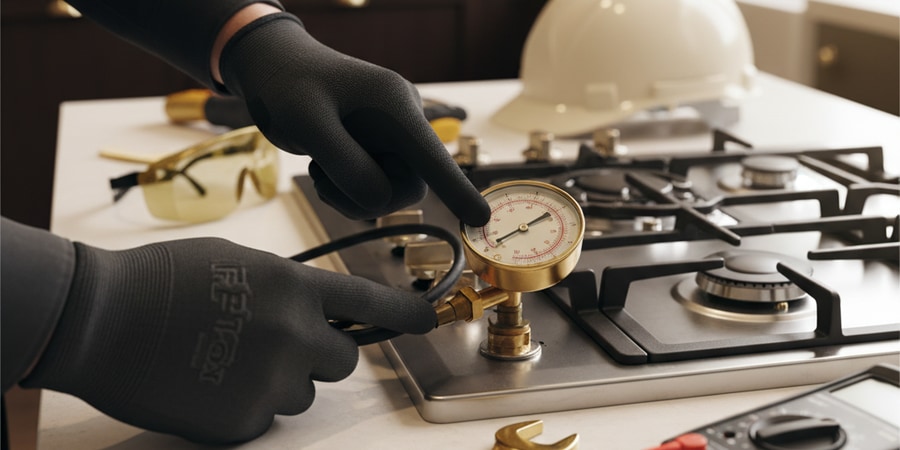
The inspection is a combination of visual checks, operational tests, and instrumented measurements. A complete annual inspection for a typical London flat takes 45 to 75 minutes. The engineer will check every appliance, boiler, hob, oven, gas fire, water heater, along with the flues, the meter, and the pipework within the demise. Specific checks include:
- Combustion performance, measured with a flue gas analyser (CO, CO2, O2 readings)
- Flue integrity: both the primary flue and, where applicable, any secondary chimney routing
- Gas tightness test on the installation as a whole
- Appliance isolation valves, working pressures, and safe ignition
- Ventilation provision: room air vents, kitchen extract, boiler air supply
- Safety devices: flame supervision, oxygen depletion sensors, overheat cut-offs
- Condition and accessibility of the emergency control valve at the meter
If an appliance passes every check, it is recorded as Safe to Use. If it has a defect that affects safety but is not an imminent danger, it is recorded as At Risk: the engineer must obtain tenant consent to leave it connected, and the defect must be rectified promptly. If it is Immediately Dangerous, the engineer is required to disconnect it on the spot, with landlord and tenant consent recorded on the job sheet.
What if the property fails the gas safety certificate?
A failed gas safety certificate is less binary than a failed EICR, most "fails" are fixable the same day or within a few days. Common remedial items include replacing a worn gas cooker hose, fitting a missing room air vent, servicing a boiler that is running out of combustion spec, and replacing corroded isolation valves. Where a boiler is beyond economic repair, the property becomes un-lettable until the replacement is installed and commissioned; for tenanted properties, temporary alternative heating must be provided if the fail occurs during winter months. Any remedial work must be carried out by a Gas Safe registered engineer, not by a general handyman, not by the tenant's cousin, and the confirming paperwork becomes part of the property record.
Gas safety certificate costs in London
A standalone annual gas safety inspection for a typical London flat with a boiler, a hob, and an oven costs £70 to £110. Properties with additional appliances, a gas fire in the living room, a secondary water heater, a gas dryer, add roughly £10 to £20 per appliance. An annual boiler service carried out alongside the inspection is typically £50 to £90 on top, and is strongly recommended: a serviced boiler fails less often, lasts years longer, and is cheaper to insure. HMOs with multiple meters or multiple appliance suites scale from £150 upwards depending on the count. Landlords on a fully managed service or inside our service bundles pay the engineer fee at cost with no mark-up.
Penalties for non-compliance with gas safety certificate requirements
Unlike most rental compliance failures, gas safety is enforced under criminal law. Landlords who let without a current gas safety certificate face unlimited fines, and in the most serious cases, where a tenant has been harmed or killed by a known but unremedied defect, custodial sentences. The Health and Safety Executive is the enforcing authority, and CO-related fatalities almost always result in prosecution. This is the single compliance item no landlord should be managing informally.
How AIHPG handles gas safety certificates for landlords
Gas safety certificates are one of the safety items included as standard in our service bundles and let only with services plans. We diarise the renewal 45 days before expiry, book the Gas Safe engineer, arrange access with the tenant, issue the certificate to the tenant within 28 days, and file the record against the property. If the inspection turns up a defect, our in-house property management team scopes and schedules the remedial work with vetted Gas Safe engineers, and the interim risk is actively managed, not filed and forgotten. For landlords managing a portfolio, renewal dates are visible in one place rather than scattered across half a dozen PDFs in different email inboxes.
The gas safety certificate sits alongside the EICR and the EPC as the three compliance documents every London landlord is expected to have current on day one of a tenancy. Running them to expiry, or, worse, past expiry, is the single most common compliance failure we see when taking over a property from another agent. None of it has to be the landlord's problem.
Related Posts.
Contact Us
Stay in touch.
Have a query or interested in our services? Contact us