
July 26, 2026
Kitchen Refresh ROI: £4k vs £14k
By
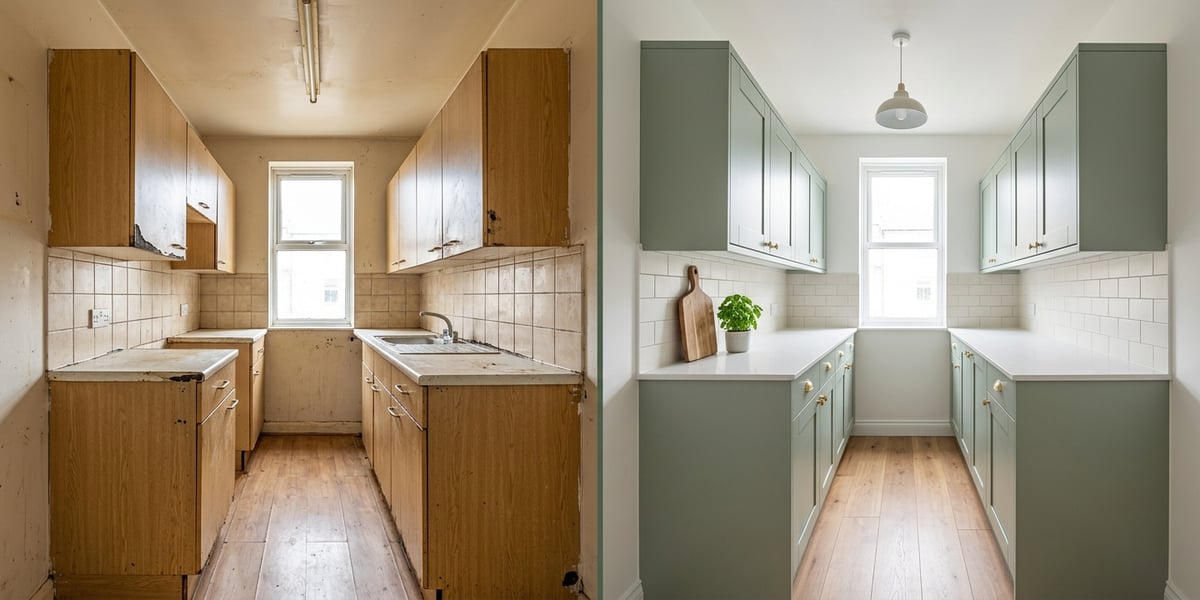
A landlord we work with in Hackney received two quotes for her kitchen. Her kitchen was structurally sound but visually dated: early-2000s oak-effect doors, a tired laminate worktop, and wall tiles that had seen better days. She wanted the flat to re-let at a higher rent, and she didn't want to be embarrassed by the kitchen during viewings.
The two quotes were £14,000 (a showroom rip-out) and £4,200 (our in-house respray-and-refresh). The rent uplift she achieved on both scenarios, modelled against equivalent comparable lets, was identical: £150 per month. The return on investment was three times higher on the £4,200 route. This is the case study that explains why.
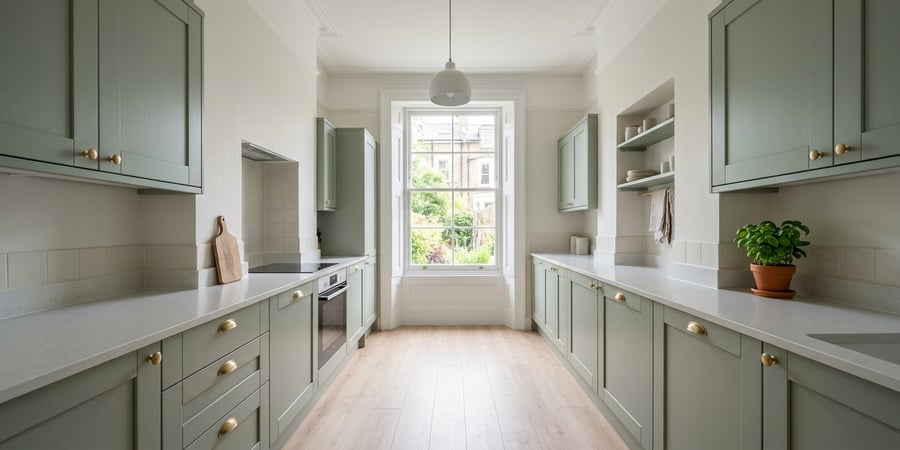
The two quotes, side by side
Both quotes were for the same kitchen: a galley-style kitchen in a 2-bed Victorian ground-floor flat in Hackney, approximately 14 square metres of floor area with 8 wall units and 6 base units.
Quote A, The £14,000 showroom rip-out
- Strip out and dispose of existing cabinets, worktop, sink, splashback
- New mid-range handleless units from a high-street showroom
- New composite quartz worktop, 40mm edge
- New integrated undermount sink and mid-range mixer tap
- New tiled splashback
- Minor electrical re-siting (one socket moved, one added)
- Re-tile floor (vinyl)
- Two weeks' installation, some re-visits for snagging
- Total: £13,800 including VAT
Quote B: The £4,200 in-house respray and refresh
- Retain existing cabinet carcasses (sound, no damp, no splits)
- Remove existing doors and drawers; supply new MDF doors and drawer fronts in a clean modern style
- Hand-spray new doors and existing frames in Farrow & Ball Downpipe (dark cabinet-style)
- New solid quartz worktop, 20mm edge
- Retain existing undermount sink; new brushed-brass mixer tap
- Metro-tile splashback re-laid in new pattern with dark grout
- New brushed-brass cabinet handles throughout
- Walls re-painted in Little Greene Shirting (off-white)
- Retain existing flooring (laminate still serviceable; deep-cleaned)
- Total: £4,200 including VAT
The finish of Quote B, because Farrow & Ball and a quartz worktop and brass hardware do most of the visual work a modern kitchen needs, reads as a deliberately-designed kitchen in a conservation-area flat. It looks intentional rather than renovated-on-a-budget.
The ROI calculation
The maths is where this gets interesting.
ROI Comparison
£14,000 rip-out versus £4,200 refresh
- Rent uplift achieved: identical £150 pcm on both routes
- Annual rental uplift: £1,800 on both
- Payback period: £14,000 route = 7.7 years
- Payback period: £4,200 route = 2.3 years
- Net present value at 5-year horizon: £14k route is still underwater; £4.2k route has netted £4,800
The rent uplift is identical because it is driven by what the tenant sees at the viewing, not by which approach produced the kitchen. A viewing tenant sees: dark painted cabinets, brass handles, a quartz worktop, white walls, a clean splashback. Both kitchens present this way. The tenant is never going to open a cabinet door and inspect the hinge mechanism; they are certainly not going to notice that the carcass is the original from 2004. What they respond to is the visual composition of the finish.
The cost difference is almost entirely in carcass replacement, and carcass replacement, for rental purposes, is almost never worth it if the existing carcasses are sound.
When the rip-out actually is worth it
A full rip-out makes sense in four specific situations:
1. The carcasses are structurally compromised
Water-damaged MDF, split side panels, failed hinge bearings, a sink base that has been soft for years. If the underlying structure is failing, respraying is painting over a problem that will come back worse. A rip-out is the right call.
2. The layout is fundamentally wrong
A 1990s L-shaped kitchen in a space that would work better as a galley; an awkwardly-placed cooker hood ducting that no modern tenant wants to deal with; a wall-sized pantry cupboard eating space that a dishwasher needs. If the layout itself is the problem, no amount of paint and hardware fixes it.
3. The property is positioned at the prime end of the market
Knightsbridge, Marylebone, Chelsea properties at the £4,000+ pcm level have tenants who will notice cabinet carcasses. For this segment, a full rip-out with a premium kitchen brand (Plain English, Naked Kitchens, or the higher end of Howdens) is often the right investment, the rent uplift at this price point is proportionately higher than at the accessible end.
4. The existing kitchen is a liability to the property's market
If your neighbouring comparables all have new kitchens and yours is the outlier, a rip-out can bring the property back into the rental-comparison set where it should be. This is a judgement call: usually the refresh-and-respray also achieves this, but occasionally the kitchen is so obviously outdated that no finish trickery makes it competitive.
In our experience across hundreds of London rental kitchens, the rip-out is the right call maybe one time in five. The other four cases, a refresh wins on ROI.
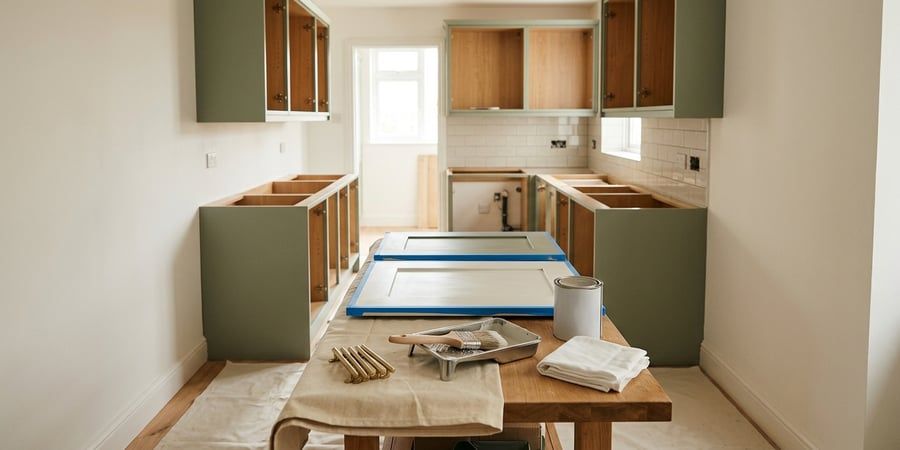
How a kitchen refresh actually works
The technical work behind a good cabinet respray is what makes the difference between a kitchen that looks resprayed and a kitchen that looks new. Done by a spray-painting specialist, the process runs like this:
- Remove and label every door and drawer front. They are numbered and photographed against their cabinet position so they go back correctly.
- Degrease everything thoroughly. Kitchen cabinets carry years of cooking oil residue in the finish. Any respray over residue fails within months.
- Sand to a mechanical key. Not aggressive enough to take off the original finish, but enough to give the primer grip.
- Prime with a high-adhesion specialist primer. Zinsser Bullseye 1-2-3 or equivalent.
- Spray two thin coats of the colour. Farrow & Ball Modern Eggshell, Little Greene Intelligent Satinwood, or Dulux Diamond Eggshell are the three best rental-grade options.
- Ideally, bake the coat between layers. Most high-end respray operations use a heated booth to cure each coat in 45 minutes rather than waiting 4-8 hours between coats. This matters for finish durability.
- Re-hang against their labelled positions. New handles at this stage if they're being replaced.
- New worktop and splashback fitted last, after the cabinet work is dry and solid.
A serious respray looks, feels, and ages like a new cabinet. A lazy respray, one that skips degreasing or primer, or uses the wrong paint, chips at the handles within six months. The difference between a £1,200 respray job and a £3,500 one is almost entirely in which of these steps was cut.
What the numbers look like at different rental levels
The £4k vs £14k case was for a Hackney two-bedroom letting at around £2,400 pcm. At different rental price points, the economics shift:
Accessible market (£1,500-£2,200 pcm)
- Refresh budget: £2,500-£3,500
- Rip-out budget: £8,000-£12,000
- Typical uplift: £50-£100 pcm from either
- Refresh ROI payback: 2-3 years; rip-out: 7-10 years
- Verdict: refresh almost always wins
Mid-market (£2,200-£3,500 pcm)
- Refresh budget: £3,500-£5,500
- Rip-out budget: £12,000-£18,000
- Typical uplift: £100-£200 pcm
- Refresh ROI payback: 2-3 years; rip-out: 5-8 years
- Verdict: refresh wins unless the layout or carcasses are problematic
Prime market (£3,500-£6,000 pcm)
- Refresh budget: £6,000-£10,000 (premium materials, bespoke work)
- Rip-out budget: £18,000-£35,000
- Typical uplift: £200-£400 pcm
- Refresh ROI payback: 2-4 years; rip-out: 5-8 years
- Verdict: refresh still usually wins; rip-out justifiable when the property is competing against other prime lets
Super-prime (£6,000+ pcm)
- At this level, a cabinet respray is not appropriate. Tenants will see it. Rip-out to a premium kitchen brand is usually the right call.
- Verdict: rip-out
The full decoration-to-re-let timeline
The Hackney kitchen refresh took 3 weeks from start to re-let. For context, here's how the timeline broke down:
- Week 1: Inspection, quote sign-off, new door order placed (2-3 week lead time), cabinet carcasses stripped and prepped
- Week 2: Existing wall tiles removed, splashback and worktop measuring completed, walls repainted, cabinet frames primed and sprayed
- Week 3: New doors arrive, sprayed and hung. New worktop fitted. New splashback tiled. New tap and handles fitted. Deep clean. Fresh inventory photography and check-in prep.
- Day 22, Listed on Rightmove and Zoopla. First viewing that evening.
- Day 29: Accepted offer at £2,450 pcm (up from previous £2,300).
- Day 37, New tenant moved in.
Total void: 37 days. At the previous rent of £2,300, that void was £2,800 in lost rent, which almost exactly matches the decoration cost. A landlord running this purely on cost-avoidance metrics breaks even on the decoration within the void window. The ongoing rent uplift of £150 pcm is the actual return.
The broader principle
The kitchen case is a specific illustration of a general truth about rental decoration. Tenants respond to what they see at the viewing: the finish, the colour scheme, the hardware, the overall composition. They do not respond to what lies behind that finish. As a landlord, spending on the parts tenants see almost always beats spending on the parts they don't.
This is why cabinet respraying beats cabinet replacement on most lettings. Why paint quality matters disproportionately (Farrow & Ball vs contractor-grade white is £80 of paint difference that reads as £200 of rent). Why brass handles at £180 transform a kitchen more than new appliances at £1,500. Why a fresh splashback at £400 changes the sense of the room more than a new floor at £1,800.
Rental decoration is not about rebuilding the kitchen. It is about presenting the kitchen. The £4k vs £14k case study is just the clearest example of how much budget is saved when you recognise the difference.
Frequently asked questions about kitchen refresh ROI
When does a rip-out actually make sense?
When the cabinet carcasses are structurally compromised: water damage, splitting MDF, failed hinge bearings, or a layout that doesn't work for a modern tenant. If the carcasses are sound and the layout is reasonable, a respray with new doors and counters almost always wins on ROI. The £14,000 rip-out is the right answer maybe one time in five.
How long does a kitchen refresh typically take?
A full respray with new doors, worktop, splashback, handles and taps takes 3-4 weeks from start to finish for a typical two-bedroom flat kitchen. The existing cabinets need to be stripped back, primed, and sprayed; door replacement is lead-time-driven (new doors take 2-3 weeks to arrive). This is within the typical void window between tenancies if planned correctly.
Will a tenant notice the difference between a respray and a replacement?
For a standard rental viewing, no. Tenants at the viewing see a modern, clean, well-presented kitchen. The difference shows up only on close inspection, the carcass design, which dates from whenever the original kitchen was installed. For rental-market purposes, this is almost never visible to the tenant and never a factor in their decision.
What's the best paint for kitchen cabinet respraying?
Specialist kitchen cabinet paints: Little Greene Intelligent Satinwood, Farrow & Ball Modern Eggshell, or Dulux Trade Diamond Eggshell in kitchen-specialist application. Cabinet doors must be properly degreased, sanded, primed, and sprayed rather than brushed to get a factory-grade finish. Done badly, a cabinet respray looks obviously resprayed; done well, it is indistinguishable from new.
Related Posts.
Contact Us
Stay in touch.
Have a query or interested in our services? Contact us